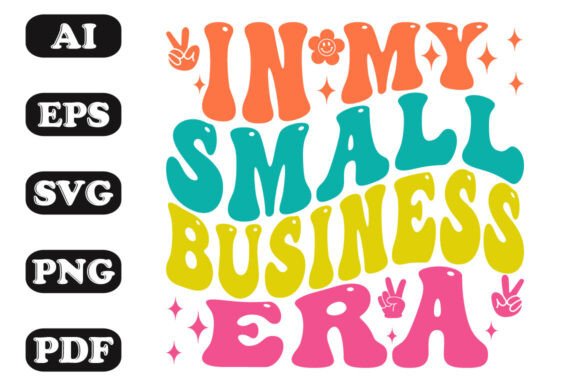
In My Small Business Era Groovy Retro Wa Review
As a designer who has spent years navigating the intersection of digital art and physical thread, I approach every new asset with a critical eye. When I first opened the file for In My Small Business Era Groovy Retro Wa, I wasn't just looking at a graphic; I was visualizing how this specific aesthetic would translate from a screen into a tangible, stitched reality. This design immediately evokes a sense of nostalgia mixed with modern entrepreneurial pride. The groovy, wavy lines suggest movement and fluidity, which is a double-edged sword in the world of embroidery. While it looks fantastic as a flat T-Shirt Designs graphic, translating those smooth curves into fill stitch or satin stitch requires careful planning to maintain the retro vibe without losing clarity.
The First Impression: Mood and Visual Personality
The core appeal of In My Small Business Era Groovy Retro Wa lies in its confident, playful energy. It speaks directly to the creative entrepreneur, the Etsy seller, and the maker who wants their merchandise to stand out in a crowded market. The typography and the undulating waves create a rhythm that feels organic rather than rigid. However, when evaluating this as an embroidery project, the first thing I notice is the density of the lines. In a digital format, these lines are crisp. In thread, they need to be spaced correctly to prevent puckering, especially on softer fabrics like cotton tees or fleece hoodies.
This design naturally belongs in the realm of custom apparel where personality is the selling point. It is not a subtle logo; it is a statement piece. If you are creating a boutique product line or preparing for a craft fair, this graphic offers a strong visual hook. The "groovy" aspect suggests a 70s-inspired color palette—think burnt oranges, mustard yellows, and deep purples—which can elevate a simple garment into a collectible item. Yet, the success of the finished product hinges entirely on how well the machine interprets those wavy edges.
Real-World Application: From File to Finished Product
Let's imagine a real-life scenario: You are preparing a batch of embroidered tote bags for a local small business owner who wants to hand them out at a farmers' market. The client loves the In My Small Business Era Groovy Retro Wa design because it perfectly captures their brand ethos. You load the digital embroidery file onto your machine, but before you commit to the canvas bags, you must consider the fabric texture. Tote bags often have a coarse weave. If the stitch density is too high in the wavy areas, the needle might struggle to penetrate evenly, leading to skipped stitches or uneven coverage.
Another common use case is sweatshirt embroidery. Placing this design on the back of a heavy hoodie works beautifully because the thicker fabric provides a stable base for the stabilizer. The bulk of the sweatshirt helps hide any minor tension issues that might arise from the complex curves of the retro waves. However, if you were attempting this on a thin tank top or a delicate baby onesie, the risk increases significantly. The weight of the thread could distort the fabric, making the "wavy" look more like a "wrinkled" mess. For baby embroidery or lightweight summer tops, you would need to downsize the design drastically and potentially simplify some of the finer details to ensure durability through frequent washing.
For the Etsy seller or handmade shop owner, this design also serves as an excellent candidate for an embroidered patch. By stitching the design onto a stiff felt backing, you eliminate the worry of fabric stretch. This allows you to sell the patches individually or offer them as add-ons to clothing items. The retro aesthetic pairs perfectly with denim jackets, caps, or even as a decorative accent on a kitchen apron. The versatility of the Graphics included in the package means you can adapt the placement easily, whether it's centered on a pillow cover or offset on the sleeve of a long-sleeve tee.
Navigating Challenges: Where Caution Is Required
While In My Small Business Era Groovy Retro Wa is visually striking, it demands respect for the limitations of embroidery machinery. One area of concern is the small text within the design. If the phrase "In My Small Business Era" is rendered in a tiny font size relative to the overall hoop size, the letters may fill in completely, losing their legibility. This is a classic pitfall in machine embroidery. Before running a full production run, always test the design on scrap fabric. Check the running stitch outlines and the fill patterns to ensure the text remains readable after stitching.
Curved surfaces present another challenge. If you plan to apply this design to a cap, the curved brim will fight against the straight path of the embroidery hoops. The wavy lines of the design might twist or pucker if the hooping technique isn't precise. Similarly, on dark fabrics, the contrast becomes critical. A white or light-colored thread against a black sweatshirt highlights every imperfection in the stitch quality. You must review the thread colors carefully. Sometimes, using a slightly off-white or pastel shade can soften the look and mask minor tension variations better than stark white.
Dense stitch areas are also something to watch. The groovy waves likely require significant fill stitch to achieve that solid, retro look. If the density is too high, the fabric will become stiff and uncomfortable to wear. This is particularly important for garments that need to drape naturally. Always inspect the back of the test stitch-out. If there is excessive waste thread or if the backing paper is tearing, you may need to adjust the settings or reduce the design size to improve the hoop size compatibility.
Practical Designer Notes for Success
To get the most out of In My Small Business Era Groovy Retro Wa, treat it as a professional asset that requires preparation. Start by testing the design on a piece of fabric similar to your final product. Use a proper stabilizer; for knit fabrics like t-shirts and hoodies, a tear-away or cut-away stabilizer is essential to prevent distortion. Do not skip this step, as it is the foundation of a clean finish.
Consider the commercial implications. If you are selling the finished items, ensure you understand the licensing terms of the machine embroidery design. Some files allow for personal use only, while others permit limited commercial sales. Confirming this before you invest time and money into materials is crucial for any craft business. Additionally, create printable mockups to show potential customers how the design looks on different products. This builds trust and helps buyers visualize the personalized gift or custom apparel they are purchasing.
Finally, think about the longevity of the product. Embroidery adds value, but only if it lasts. Ensure the thread colors are vibrant and fade-resistant, especially for items that will be washed frequently. The In My Small Business Era Groovy Retro Wa design has the potential to become a signature look for your shop, but only if executed with precision. By paying attention to detail, choosing the right fabric, and respecting the mechanics of your machine, you can turn this groovy graphic into a high-quality, professional finished product that your customers will love.